Wednesday, December 17, 2008

Buying, Being, Creating and Consuming in Second Life - Part 1

This post began more than a month ago as a (thankfully unpublished) rant about what I termed "The Cult of the Creator Class" in Second Life. It was born out of my frustrated attempts to move purchased assets such as shape, skin, clothes and furniture from Second Life to an Open Simulator Grid. But as I pondered the reasons behind the draconian Digital Rights Management I battled, a number of questions came to mind that defied easy answers:
  • Why are the vast majority of digital goods in Second Life -even freebies - hobbled by copy, modification or transfer restrictions?
  • Why hasn't the incredible grassroots creativity in Second Life spawned a Share/Remix culture, instead of the current one that supports the hording of IP rights and control?
  • Why is the program feature that permanently embeds a creator's name into every Second Life object generally perceived as an ethical imperative?
  • What do many creators I speak with get so riled up at the thought of someone "taking credit" for their work, even if there is no financial impact?
I realize there are financial dimensions to these questions and promise to address those factors in a subsequent post. For now I pose the question:

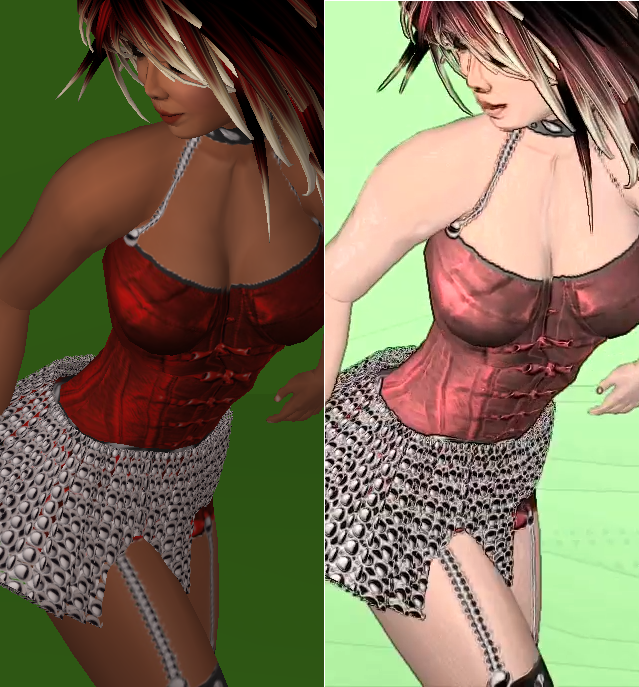
Do you think I'm hot?

After almost a year since Botgirl's rezday, I am still taken aback when someone says something like "You're so beautiful" in reference to the visual form of the Botgirl avatar. Obviously "I" am not the pixelated form they see, right? A more accurate statement would be "Your avatar is beautiful," but I can't remember a single instance of anyone phrasing the sentiment in such a fashion. I don't think the blurring of our selves and our digital forms is just fuzzy semantics. In fact, I think the language is a pretty accurate reflection of our psychological perception.

So what the hell does this have to do with DRM and intellectual property? It seems to me that in the pseudonymous environment of Second Life our creations are experienced as significant and perhaps inseparable aspects of our digital identity; of who we are. Our atomic identities are the complex result of decades of life experience. Our digital personas are a year or two old and formed from a relatively narrow realm of relationships and activities.

Our creations in Second Life are viscerally experienced as essential aspects of our digital identity. And by creations, I don't just mean the prims we build, but also the creative activity of combining purchased items to form our bodies, wardrobes and environments.

I think there is a kind of inherent tension between creators and consumers in virtual worlds that transcends economics and does not have a clear comparable in the atomic world. The tension is between the identification of the creator with the objects they birth, and the identification of the consumer with the objects she acquires and integrates into her form and environment.

I'll leave it here for now. Stay tuned for Part 2.


Tuesday, December 16, 2008

Studio Artist Software Opens New Dimensions for Second Life Photography and Machinima Making

Studio Artist is an amazing software program that can generate a vast range of paint, vector and image processing effects on stills, video files and even live video streams. The image below shows detail of an original and auto-rotoscoped frame from the video I posted yesterday.

The Macintosh-only software can create effects unlike any other program I've run across, including resolution-independent simulations of painting styles, time-based processing and multiple key-frame effects chains.

I'll share more of its features over the coming months as I apply them in Second Life projects. For now, here's a pretty detailed review of the software from Mac Animation Pro.

rotoscoping detail

I'll

Monday, December 15, 2008

My first shot at rotoscoping video created in Second Life

For best viewing, download the 1280 X 720 Quicktime file here by right-clicking and saving to your hard drive.

Sunday, December 14, 2008

More Games Our Brains Play

Here's another video from Ted Talks related to the mental construction of reality. This one is a lecture by Philosopher Philosopher Dan Dennett. It starts off a bit slow, but eventually presents some compelling evidence that "not only don't we understand our own consciousness, but that half the time our brains are actively fooling us."


Saturday, December 13, 2008

Why Seeing Shouldn't Be Believing

Yesterday's images crudely demonstrated how just a little resolution enhancement can ruin one's enjoyment of erotica. Magnification can break down our typical experience of a virtual world by revealing the underlying absence of detail and complexity. Magnification can cut through our normal perception of the physical world by revealing almost infinite levels of detail and complexity.

This fun video by neuroscientist Al Seckel demonstrates some of the ways the mind interprets and misinterprets visual imagery.

Friday, December 12, 2008

Wednesday, December 10, 2008

And the HD Hosting Winner is Blip.tv

The last post linked to versions of an HD test video uploaded to YouTube and Vimeo. Video hosting services don't stream your original video, but re-encode to fit their particular display formats. So quality can vary quite bit depending upon the specifications of the original video you upload and the particular way a service renders into their final format.

Vimeo produced the best image of the two services I tried yesterday and was the least picky about image format. Today, I uploaded to blip.tv, and in my opinion it's the all around best choice. The image quality is as good as Vimeo, plus it's the only option that supports embeddable HD video (although I don't have the width available here for the full resolution.)

Followers

Blog Archive

About Me

My photo
A beautiful thought experiment personified through the imagined perspective of a self-aware avatar. My creator's site can is at http://fourworlds.tumblr.com