Thursday, August 14, 2008

Botgirl & Night augment immersively for comic collaboration

Night and I met Tuesday evening to discuss the latest draft of our first joint comic collaboration. I uploaded the draft images and threw them on a couple of gallery poster boards. Wow! What an amazing way to work on visual material together. I got my handy Sketch Sky Pens out of inventory (you can see a red circle drawn in the second image) and we had a great, fun session.

I'll return to Avatar identity next time.

Comic Meeting 1

Comic Meeting 3

Wednesday, August 13, 2008

What's so special about avatar identity?

Writing this blog feels like walking through an unknown wilderness at times. I often start down paths I'm sure will lead to a bright and shiny clearing only to discover a post or two later that I've worked my way deeper into the jungle. But the journey's usually interesting and I hope you don't mind me dragging you along on a few wild goose chases.

For instance, this week started out with a promising set of images that finally clarified (for me at least) the separation between immersion and virtual identity. Unfortunately, I think I moved way too fast through a textual description and got a bit lost again. So I'm going to take a virtual breath, slow down and look more closely at avatar identity. I'm not aiming to draw any conclusions today. Let's just explore the territory.

I'm going to begin by making a short list of what I think is true about avatar identity and work from there:
  • Beings experience avatar identity in many different ways, ranging from feeling like there is absolutely no difference between human self and avatar identity, all the way up to the experience of a complete split.
  • Some beings experience themselves as an avatar personality that is fully individuated and separate from the human person who shares their brain. Regardless of debate about whether avatar personalities are "real," I am convinced that the beings I know who describe this high degree of segmentation express authentic experience.
  • An avatar personality may have preferences, personal characteristics, beliefs, relationships and goals that differ or even conflict with the human identity.
  • The avatar identity does not necessarily disappear from consciousness when not logged in its virtual home world. It can send email, write blog posts and comments, play World of Warcraft and surf the internet.
  • An individual may experience varying degrees of any of the above over time, even from moment to moment. However, some beings report a very solid and consistent experience of a separate self.
Okay, that's a start at least. So now let's see if there are any non-virtual parallels to this phenomenon.

It is not uncommon for a human to describe feeling at times like "two different people." Although they don't change names or bodies people can experience and express very different personalities depending upon the context. At work, Mary may dress conservatively and act aloof, prim and proper. Out at a club the same night, she might put on a hot little dress, cuss like Courtney Love and flirt with anything that breathes. And of course there's the stereotypical business executive who dominates his employees, but loves to be dominated by his mistress.

Actors, comedians, musicians and other performers can feel as if their onstage personality is quite different than their offstage self. Something emerges when they perform that feels quite different from their everyday personality. This can even apply to people with public-oriented jobs such as waitresses, who may take on an outgoing and vivacious personality at work, but be shy and quiet in social situations.

I'll leave it here for today. Anyone have other examples of non-virtual personality shifts? What if any connection do you think there is between the human/human and human/avatar examples I described? What if anything is special about avatar identity?

Tuesday, August 12, 2008

Spectatorship, Immersion and Emergence: Part Two

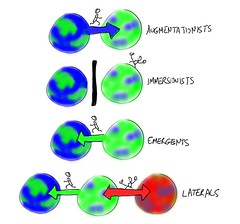
Back in May, I introduced the term "Emergents" as a label for virtual personalities who travel outside their world of origin through online vehicles such as Twitter, Flickr and Facebook. What I missed (as you can see in the associated graphic) was the psychological dimension.

This blind spot contributed to the disconnection some readers noticed within my recent AIR-based relationship theory:
"the contradictions in the 'AIR' theory doesn't really work out unless you can explain persistent relations through periods of non-immersion for starters." Digado
After my latest round of inquiry, I believe that what persists are virtual identities independent of the immersive environment except for associated memories, thoughts and emotions. This became apparent as I went through a VizThink exercise over the weekend that facilitated the depiction of the SIm-E process (sorry, I love acronyms) I posted yesterday:
  1. Spectatorship: New users initially experience a virtual world as if they are on the outside looking in. Without the feeling of being inside the world, there's not much point in spending a lot of time there, unless it's related to a job or there's some other compelling motivation to persevere.
  2. Immersion: Most newbies seem to need a dozen or more hours inworld before they cross the border into the visceral experience of being inside a virtual world. Although the term immersion encompasses multiple dimensions across a spectrum of intensity, many people describe their initial experience as a sudden shift of perception, as if a switch was turned on.
  3. Emergence: It is possible to have a very full experience of immersion without developing a unique virtual personality. That said, it seems that most active Second Life residents I've encountered describe some sense of a virtual identity that is psychologically individuated from their human self. For instance, one avatar with very close and emotionally intense inworld ties said that her human identity was ambivalent about her online relationships. So the identity that writes a loving blog post to her online loved ones is not the human, but the virtual. These identities don't merely persist outside of the virtual world on the web, but persist within consciousness. This brings up all kinds of questions about human personality and identity.
I'll continue this thread in the next post.

Monday, August 11, 2008

Spectatorship, Immersion and Emergence

This is a continuation of a topic thread relating to "AIR-based relationships." AIR = Anonymous identity + Immersive environment + Romantic attraction.
Spectator: one who looks and watches
Immerse: to plunge into something that surrounds or covers
Emerge: to become manifest : become known : to come into being through evolution
From Mirriam Webster
I did some visual thinking over the weekend and realized that I’ve been focusing on the what and missing the who in my exploration of AIR-based relationships. Here are some excerpts from that process. I’ll follow up with commentary in my next post.

Observer to Emerger

Friday, August 8, 2008

Avatar self-portraiture on Flickr: Art or Onanisim?

blockprint


What's up with the incredibly prolific avatar self-portraiture evidenced on flickr? Here are a few categories I've noted:
  • The shiny new parent/lover/toy syndrome: I have a pair of childless human friends who got married and bought a small dog. I must have received links to a hundred or more images for the first couple of month: Dog on the couch. Dog in the yard. Dog in the boat. Dog with the cute hat. I haven't seen any research, but my guess is there is some logarithmic curve downward for how many photos are produced for subsequent pets, children avatars, etc.
  • Neo-Narcissism: This applies to Immersionists, both open and closeted. It seems to me that if one identifies personally with the avatar form, then having a gazillion photos of oneself on display on flickr is equivalent to a human doing the same thing. Obsession with one's physical form isn't always ickishly shallow. Not always. And self-love can be a beautiful thing. Or self-lust.
  • Avatar as canvass: For those with a bona fide artistic nature, or wannabe's like me, we will never find a more patient model than our own avatars. They will pose for hours without complaining. They never ask for a royalty check. Although they may not be easy to work with, it's certainly a familiar and comfortable relationship. And you always get to sleep with the hot model, right?
Although this is a somewhat tongue-in-cheek post, my guess is that there are multiple elements at work in many of our photographic exploits. Did I miss any categories, whether serious, semi-serious, farcical or otherwise?

Have a good weekend.

Thursday, August 7, 2008

Lifestream visualization

Most people use lifestream applications such as Friendfeed and MyBlogLog primarily to log and view current happenings. Another interesting way to use the collected information is to visualize it over time. Here are a few examples and resources:

Dipity (Image below is interactive. Try setting zoom level to "week.")


favthums

Favthumbs del.icio.us visualization

Swurl


Swurl

Wednesday, August 6, 2008

Botgirl vs. Human comic book available for inworld reading

You don't have to be an Immersionist to read the intellibook version of Botgirl vs. Human in Second Life. Pick up a free copy at my almost-completed gallery in Extropia. It's on the bar. Right click and buy for $0.

Botgirl vs Human Book for inworld viewing

Botgirl vs. Human comic book available for inworld reading

Followers

Blog Archive

About Me

My photo
A beautiful thought experiment personified through the imagined perspective of a self-aware avatar. My creator's site can is at http://fourworlds.tumblr.com