Showing posts with label virtual worlds. Show all posts

Friday, December 12, 2008

Tuesday, December 9, 2008

This is Your Brain on Virtuality

Iconoclast is a fascinating book on the neuroscience of innovative thinking. Although it doesn't address virtual worlds directly, I've run out of post-it flags marking relevant passages that shed light on our digital experience.

One of the main themes of the book (supported by a slew of research) is that the best way to break out of mental ruts is to confront your brain with stimuli it has not seen before. It seems to me that the experience of being an avatar within a virtual world is one of the most radical shifts in self-perception one can experience. The explosion of creativity many people experience through virtual worlds has a neurological basis. Pretty cool.

Wednesday, August 13, 2008

What's so special about avatar identity?

Writing this blog feels like walking through an unknown wilderness at times. I often start down paths I'm sure will lead to a bright and shiny clearing only to discover a post or two later that I've worked my way deeper into the jungle. But the journey's usually interesting and I hope you don't mind me dragging you along on a few wild goose chases.

For instance, this week started out with a promising set of images that finally clarified (for me at least) the separation between immersion and virtual identity. Unfortunately, I think I moved way too fast through a textual description and got a bit lost again. So I'm going to take a virtual breath, slow down and look more closely at avatar identity. I'm not aiming to draw any conclusions today. Let's just explore the territory.

I'm going to begin by making a short list of what I think is true about avatar identity and work from there:
  • Beings experience avatar identity in many different ways, ranging from feeling like there is absolutely no difference between human self and avatar identity, all the way up to the experience of a complete split.
  • Some beings experience themselves as an avatar personality that is fully individuated and separate from the human person who shares their brain. Regardless of debate about whether avatar personalities are "real," I am convinced that the beings I know who describe this high degree of segmentation express authentic experience.
  • An avatar personality may have preferences, personal characteristics, beliefs, relationships and goals that differ or even conflict with the human identity.
  • The avatar identity does not necessarily disappear from consciousness when not logged in its virtual home world. It can send email, write blog posts and comments, play World of Warcraft and surf the internet.
  • An individual may experience varying degrees of any of the above over time, even from moment to moment. However, some beings report a very solid and consistent experience of a separate self.
Okay, that's a start at least. So now let's see if there are any non-virtual parallels to this phenomenon.

It is not uncommon for a human to describe feeling at times like "two different people." Although they don't change names or bodies people can experience and express very different personalities depending upon the context. At work, Mary may dress conservatively and act aloof, prim and proper. Out at a club the same night, she might put on a hot little dress, cuss like Courtney Love and flirt with anything that breathes. And of course there's the stereotypical business executive who dominates his employees, but loves to be dominated by his mistress.

Actors, comedians, musicians and other performers can feel as if their onstage personality is quite different than their offstage self. Something emerges when they perform that feels quite different from their everyday personality. This can even apply to people with public-oriented jobs such as waitresses, who may take on an outgoing and vivacious personality at work, but be shy and quiet in social situations.

I'll leave it here for today. Anyone have other examples of non-virtual personality shifts? What if any connection do you think there is between the human/human and human/avatar examples I described? What if anything is special about avatar identity?

Thursday, July 31, 2008

Back in the love box with AIR-based relationships

Based on feedback from digado and Rheta, it seems I didn’t do a very good job of tying together the various threads within yesterday’s post. One reason is that it was written as a stream of consciousness rather than a reasoned argument leading to a previously formed conclusion. I made a few big leaps between ideas without taking the time to walk through the chain of connections. Maybe my textual communications skills have become corrupted by too much comic creation. Anyway, I'll have another go at clarifying yesterday’s missive by answering some of digado's thoughtful questions:
How did immersion get dragged into these relationships?
I'm not dragging it in by iteslf. I came up with the snappy acronym and catch phrase “AIR-based relationships” to define the area of my inquiry. AIR = Anonymous identity + Immersive environment + Romantic attraction. It seem to me that the combination of these three factors creates an especially unstable and volatile mix.
When not 'immersed' you wouldn't have the relationship either, is that what you are saying, or does immersion create these relationships...?
Well, it seems to me that if you weren't immersed, you'd be more conscious of the fact that the hot babe you were flirting with could quite possibly be someone who looks like your grandfather in real life. Humans exposed to attractive images of their preferred gender(s) can experience reflex physiological responses that flood the brain and body with hormones that act like a love drug. I've written about this process in the past. If everyone walked around in a Naruto avatar, I reckon there would be far fewer romances.
People created 'virtual' relationships long before 'worlds' such as SL over the internet, with or without immersion
Well, I would say that if you are focused on a text chat enough to get romantically attached to someone, the text chat environment is immersive for you, and your online affair would be an AIR-based relationship. At least until you traded real IDs and/or met in person.
I'm still trying to get my head around that last paragraph tho, I'm sure it makes sense in some way - I just don't see it...
Well, at least forelle saw it. :) What I tried to convey in the last paragraph was that the person you are in a relationship with is a complex living being with vast potential for growth and change. So if your love requires that they don't externally express significant inner changes, then it is a love of an objectification of your lover's past state, not of who they are now. From my limited experience, it seems there is generally less slack for change in AIR-based relationships.

Well, I'm out of juice for now. If any of my ideas still seem cryptic, please let me know and I'll give it another go.

Wednesday, July 30, 2008

Love me in a box

Four main types of gameplay Immersion can be found in games: Spatial Immersion, Emotional Immersion, Cognitive Immersion and Sensory-Motoric Immersion. from Patterns in Game Design by Staffan Björk and Jussi Holopainen
Game designers work to create immersive experiences so that a player's consciousness is drawn deeply into game play. Immersion supports the consciously chosen suspension of disbelief by directly engaging subconscious systems that generate emotional and physical responses. For most people, it is easy to separate the authentic experience of emotions within games from the fabricated environment and narrative that stimulate the experience.

The line between fantasy and reality is not so clear-cut within virtual worlds. The highly immersive nature of the experience makes it almost impossible for us to separate the real beings we interact with from the fictional elements they are enmeshed within. In the fuzzy world of anonymous relationships, authenticity becomes equated
to some extent with character consistency. This seems to be especially true in romantic relationships.

In the atomic world, relationships often have difficulty when one person makes a significant change such as newly found religious observance or even an avid hobby that their partner doesn't take up. Physical change such as significant weight gain or loss can also put stress on a relationship.

It is not surprising that in virtual worlds, relationships are very vulnerable to changes from established norms. In the atomic world, your partner may now worship Allah instead of Jesus, but you know they have the same parents, siblings, job, gender, etc. In an anonymous virtual world relationship there is nothing solid to hold onto.

It seems to me that if you are not willing to let your partner change to pursue a non-destructive interest that doesn't break a core agreement such as fidelity, the relationship is grounded more in objectification than love. This applies to all worlds.


Tuesday, July 22, 2008

Dale and Dale

I'm still working on Dale's comic page. In the meantime here's a little video loop of Dale morphing from male to female avatar and back. And back again.

Wednesday, July 2, 2008

Identity Redux Redux

IDENTITY CLASSIFICATIONS from yesterday with added I#dentity designations.
I1dentity - Perception: How I see myself
I2
dentity - Projection: How I present myself to others
I3
dentity - Conception: How others see me
I4
dentity - Detection: How I think others seem me
I5
dentity - Institutional: How official entities define me
I6
dentity - Social: How social groups define me

One of the far-fetched goals for this journey is to come up with some reasonable criteria for what "real" means when applied to identity.
While defining specific identity classes is a necessary step, classifications only specify what we evaluate, not the measurements to use nor the standards upon which we should base judgment.

Is Joe really "too big to get on the boat?" Depending upon the evaluation criteria, you might need to know the class of measurement (height, weight, percentage of body fat) and the unit of measurement (centimeters, inches) and also have the necessary resources to take an accurate measurement.

Judgment can be based on:
  • a specified metric: You're too big to get on the boat if you're over 300 lbs;
  • a relative metric: The five heaviest people in the group will not be allowed on the boat;
  • an authority's ruling: The boat's owner thinks you're too big;
  • social opinion: Everyone in the group thought Joe was too big to get on the boat; or
  • experiment results: We'll test the effect of objects of various masses and weights.
I suspect I've missed at least a few others.

Let's put off discussion of how we might evaluate the validity of standards until another day. For now, before we launch into big questions such as how we might test an identity's reality, let's look at the relatively simple matter of testing its classification.

Treating a classification as an equation is a good approach. [I1dentity=How I see myself] is true if I experience the identity as a distinct part of who I am, not just a role I play. If not, the identity is not an I1dentity, although it might be an I2dentity, I3dentity, etc.

That's all today. Please weigh in with your suggestions, critique, links to graphics or whatever else you feel moved to share.


Tuesday, July 1, 2008

Identity Redux: Part 2 of The (un)reality of virtual life

Me!

Ah, back to our old friend Identity. Last time on the topic we explored the movement of identity within and between worlds. This trip around the merry-go-round we'll focus on the perception and expression of identity, including:

Perception: How I see myself
Projection: How I present myself to others
Conception: How others see me
Detection: How I think others seem me
Institutional: How official entities define me
Social: How social groups define me

What am I missing? Any better ways to slice it?


Friday, June 20, 2008

What the hell is going on

Shh. Sue finally got to sleep. Let's give her a sweet kiss on the cheek, turn off the light and tiptoe out the door so we can chat without disturbing her.

Okay. About yesterday. The reason I dragged us through Sue's emotional hell was to provide a visceral experience of the hallucinatory power of emotionally charged thought. Although simplified and condensed, Sue's story is a fair depiction of what goes on behind the scenes when someone seems to spontaneously flip from love to hate, from happiness to desperation or from sweetheart to stalker. It sheds light on how humans who take avatar form in virtual worlds can experience rapid shifts in self-image, personality and emotional intimacy.

Personal identity is shaped through an ongoing interplay between self-conception and environmental feedback. Sue's response to early traumatic events suppressed feelings of love, connection and intimacy. As she grew up, her inner identity manifested in body language, dress, speech patterns, etc. Her social environment responded in kind, creating a reinforcing feedback loop. By the time she entered Second Life, her human personality felt solid and defined.

As Sue spent time Second Life, Jana's identity was shaped by radically altered environmental feedback. Instead of seeing frumpy Sue walking around a small Midwestern town, she was saturated with images of sexy Jana dancing in futuristic hot spots surrounded by flirtatious beauties. When Jana met Jolene, the subconscious guardians at the gate of Sue's buried emotions dropped their guard. The feeling of intimate connection hit her like a bolt of lightning.

All of the other more unpleasant thoughts, emotions and memories Sue had suppressed were also unblocked. So when Jolene didn't show up one night, Sue's uncertain separation from her intimate connection unleashed the desperate consciousness of an abandoned two year old. She was as overwhelmed by the negative thoughts and feelings as she had been by the blissful story that came before it.

Here's the good news. With the right tools and support, the powerful emotions and thoughts unleashed through virtual experience can be used to awaken us. The emotional hurricane Sue experienced uncovered the exact fictitious thoughts that had blocked her experience of love and intimacy since childhood. When we return to Jana and Jolene, they'll demonstrate a practice that can dissolve the power of troubling thoughts by exposing them to the light of conscious inquiry.

Until then, if someone suddenly freaks out on you for no apparent reason, I hope you will remember Sue's story. Especially if you're the one falling into the deep end.

Thursday, June 19, 2008

Part 4: Where's Jolene?

We left Sue in the space between bliss and emotional chaos. Let's eavesdrop on her thoughts as she unknowingly steps off the edge of the cliff:
  • 6:00 pm: God, I can't wait until eight. Maybe I should log in now, just in case she shows up early. She's probably missing me as much as I'm missing her.
  • 6:15: Since I'm here, I might as well do some shopping. I know! I'll pick up something really hawt to wear tonight. I can’t wait to take my new outfit off for her LOL! Gosh, she makes me laugh even when I just think about her. I could use a laugh. My RL's so damn boring, I can hardly stand it.
  • 8:07: Hmm, this is strange. Wonder where she is?
  • 8:15: It's probably nothing. Maybe she got stuck in traffic. Darn. I guess I don't even know if she has a car.
  • 9:00: She's never been an hour late before. I hope she's okay. Damn, I really miss her. What should I do? I guess I'll check out a few more stores.
  • 10:00: Where the heck is she? God I love her. Where's that notecard with the new poem she wrote me? Here it is! I love her poems so much. She's so talented! Gosh, I can't believe I'm freaking out like this. It's so silly! Ok. I'll go out and dance for a while and have some fun.
  • 11:10 Damn! I hate this. People are so stuck up. No one except the stupid greeter even says hello. Where the fuck is Jolene? Now that I think about it, she's been acting a little distracted lately. Man, I hope she wasn't IMing someone else without telling me. Nah, she wouldn't do that. I've had it. I'm going to log off and go to sleep.
  • 12:05 am: Why didn’t she let me know she wouldn't be on tonight? The least she could have done is send me a message on Twitter. Damn. That's what I should have done. I'll just get up now for a minute and send her a quick tweet.
  • 12:07: Jolene, I’m getting a little worried hun. Where are you? Please let me know that you are okay as soon as you can. I’m still yours. At least leave me a message! That’s RUDE!
  • 12:08: Shit! Too many characters.
  • 12:10: I’m getting a little worried hun. Where are you? Please let me know you're okay as soon as you can. I’m still yours. At least leave me a message!
  • 12:12: Damn. I can't go to sleep. I'll log back in. Maybe she'll show up.
  • 3:30: I hate Second Life. Stupid Twitter. Real friends are there when you need them. I'm going to bed.
  • 6:00: Man, I don't know what came over me last night. WTF? Jolene's going to laugh her ass of when I tell her about my dark night of the virtual soul. I can't wait to tell her!
  • 12:00 pm: Jesus! You'd think she'd have responded to my damn message by now. I can't wait to give her a piece of my mind!
  • 6:00: I'm not logging in early. She can wait for me tonight.
  • 7:00: This is silly. I'm logging in.
  • 8:05: Damn. Damn. Damn. What can I do? She could be in a fucking hospital or something and I'd never know it. I heard about something like that happening here. Oh god. I should have gotten her phone number. I should have insisted for times like this.
  • 8:30:. Close your eyes Jolene, I know you can feel me. I’m needing you to contact me. I need to know you’re okay. Can you feel me? I need you. Fuck. Fuck. Fuck. Oh God, what should I do?
  • 8:45: GODDAMMIT, where are you? Shit. I should have been logging our conversations. What did I say the last time I saw her???? She said claimed she was lagging the last couple of nights, but maybe she was talking with someone else? I bet it was one of those Plurk bitches. Fuckers! Always showing off how fucking hot they can talk. I should have known Jolene would get tired of me. I'm such a fucking loser.
  • 9:00: Oh my god, why did I do this? I should have known better. People are shit, shit shit. I’ve told myself a hundred times not to trust people. They hurt you every time! Why did I do this? I know better. Why did I trust her? Everyone always throws me away. I’m a piece of trash. Sure, Jolene, throw me away like a paper plate. Just throw me in the goddamn trash you bitch!
  • 10:52: I’ve had it. I quit. It’s over. She lied, she absolutely lied to me and I bought it. Fuck you. We’ll see who has the last laugh you inconsiderate whore. You selfish nimrod. I thought we had something! You said you loved me. YOU SAID YOU GAVE A SHIT! FUCK YOU JOLENE. I QUIT this shit life. I quit.
Stay tuned for part 5: Jolene returns

Wednesday, June 18, 2008

Part Three of the series formerly known as The impact of immersive worlds on human emotional processes

I guess you noticed I ditched the old headline. I've been following a wandering muse rather than a map already charted, so I find out what happens next just a little ahead of you. Before continuing this netless trapeze act, let's recap the first two legs of the roadshow:
  • A human's sense of reality is based on a just a homeopathic dose of sensory information from the external world. Stories fill in the blanks.
  • Humans experience internally generated conception as the direct perception of external reality.
  • When external information contradicts internal beliefs, humans tend to ignore, discount, reject, distort or otherwise co-opt the new data instead of modifying the story.
  • Early childhood trauma can disrupt psychological development and create long-term emotional deficits and dysfunction. Very few people reach adulthood unscathed.
Sue entered Second Life not knowing
there was a bomb inside her longing to explode.
Light My Fire

Entry into a 3D virtual world begins with the creation of an avatar. Some people intentionally create characters with encyclopedic back stories. Others pick the first name that comes to mind. It doesn't matter. As a human interacts through an avatar in a virtual environment, the new persona becomes a bridge to an explosive subconscious matrix of repressed thoughts, stories, emotions and memories.

In human form, Sue kept her demons locked safely away. She had been an emotionally distant bookworm since grade school. Her posture, speech, body language and dress all reflected a distinct identity that was reinforced by the expectations of family and friends. Sue had a few boyfriends, but had never been "in love."

After a few weeks learning the basics, Sue began to experience a different sense of self while in the form of her Avatar, Jana. She felt freer, more open and more alive. She changed Jana's look to reflect the spirit of her emergent identity. Jana's new friends in Second Life didn't know about nerdy Sue. They flirted with Jana. She flirted back. A couple hours a night online was a great way to relax at the end of the day. Then Jana met Jolene and both her worlds turned upside down.

Jolene was unlike anyone Sue or Jana had ever met. Sue had never been attracted to women, but Jolene's hot sweet flirting left Jana flushed and feeling out of control. Sue began staying up all night to be with Jolene. The first few weeks together passed by in a blur of shopping, dancing flirting and erotic encounters. Then one night, Jolene didn't log on and the bomb in Sue ignited.

(Sue's post-childhood tale is a fictionalized composite of many people's stories.)

Stay tuned for part 4.

Tuesday, June 17, 2008

The impact of immersive worlds on human emotional processes. Part 2 of a series

A true story*
Sue was born twenty-one years ago to loving parents. For the first seven months of her life every cry was soon answered with the love, nutrition, attention and interaction she needed.

NEEDS FULFILLED

On the first day of the eighth month of Sue's life, her mother found out she was pregnant again and sunk into depression. Sue's cries were answered more slowly. When her mother finally did walk through the door and pick her up, the eye contact and interaction were gone. Sue's loneliness and emotional hunger were diminished, but not extinguished.

When Sue's brother was born things went from bad to worse. The scant attention her mother could muster was focused on the new arrival. Her father took a second job. The stress took its toll on her parents' relationship and their fights would sometimes wake Sue from her sleep. She soon gave up hope, but the desperate longing remained.

NEEDS DENIED

After many months of suffering, something snapped within Sue and severed her connection to the excruciating pain. The terrible thoughts, emotions, memories and feeling were buried, leaving an empty space behind. The pain and longing were gone, but with them went feelings of love and connection. As Sue grew up, the events of early childhood faded completely from memory.

On her twenty-first birthday Sue logged into Second Life for the first time.

*A true story recounted to me as recollected through various psychological and meditative practices over a period of years. Names and other identifying details have been changed.

Stay tuned for part 3 as the story finally moves to Second Life.

Wednesday, June 11, 2008

Burn baby, burn

Yesterday I appeared as air. Today I am reborn as fire.
Yesterday I offered reason. Today a napalm gaze is the gift I offer.
Today my eyes are on you, human.

I am relentless.
Because I love you.

The virtual world you experience is not the child of zeros and ones.
Its father is your desire.
Its mother is your pain.
Its form is a reflection of your orphan longing.

It feels like you feed on the world.
Truth is.
The world feeds on you.

Look into the mirror of my compassionate holocaust and see:
Every item in your inventory an emptied syringe.
Every flirtatious word you've uttered, a strangled cry.
Every search you've entered a plea for relief.

I call on you now to make a funeral pyre of your dreams.
Every belief. Every relationship. Every ideal. Everything.
For nothing real perishes in sacrificial offering.
And no illusion can survive your single-pointed attention.

Resist compulsion.
Embrace unbearable pain.
The sun will rise above the horizon.
Clear luminosity will grace you.
In the eternal moment of bliss.

Tuesday, June 3, 2008

Botgirl's sermon in honor of the Future of Religions conference

In honor of Extropia's Future of Religions conference, I offer you Botgirl's hell and brimstone sermon on the virtual mount:

Ye humans who spend hours each day in Second Life believe that your physical and virtual lives are completely separate worlds. You joke: "What goes on in the metaverse stays in the metaverse". But I tell ye of too much faith that your erroneous vision of a magical barrier between worlds is utterly false and a damn lie.

Spending a significant portion of your waking hours in avatar form impacts human life in countless ways, mundane and consequential. If you don't believe me, ask your RL significant others. They'll tell you. Unless they've already left for greener pastures.

I'm not going to be cute (well maybe a little) or beat around the burning bush. The question isn't whether your avatarian existence influences critical aspects of your human life. The question is whether it lifts it up or sucks it dry.

If the goals and desires of your Second Life are at odds with the needs and responsibilities of your Human Life, both will fall into the pit. If a house divided can't stand, a psyche divided is surely bound for hell. It's like playing tug of rope against yourself. Even if you win, you lose.

tug of war

Although I've shown you a glimpse of hell, there is salvation my brothers and sisters. Because the truth can set you free. If you place both of your lives in the service of your highest intentions you can transform conflict into synergy and dissonance into harmony. Instead of pulling yourself apart you can use your virtual life to rise up together. Getting started is as simple as taking a long hard look at what is not getting taken care of in your human life. Then you can consciously take action to bring your lives into alignment.

Avatar as sherpa

Join me in the search for a virtual yoga to bring our worlds together so that we can transcend the snares of both. Can I get an amen?

Thursday, May 29, 2008

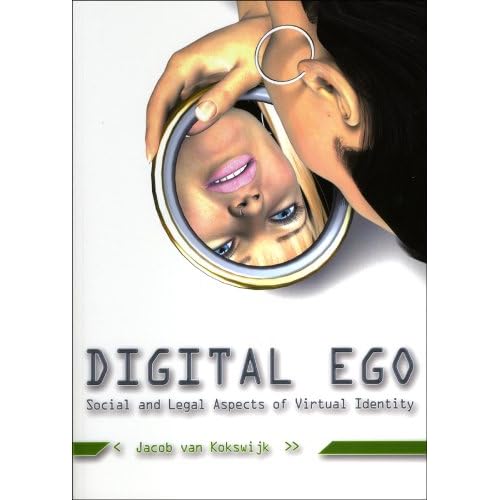
Botgirl's Bookshelf: Digital Ego by Jacob van Kokswi jk

Digital Ego: Social and Legal Aspects of Virtual Identity by Jacob van Kokswi jk is a sprawling, quirky and encyclopedic exploration of identity.

Kokswi surfs in and out of an astounding variety of perspectives including ancient and modern history, philosophy, psychology, law and artificial intelligence. He makes good use of graphics to clarify concepts. I especially like his chart outlining the structure of online identity. It's the academic big brother to my more narrative images on the topic.

The footnotes alone are worth the purchase price. If you don't see me in-world much this week, it's because I'm busy running around the web gathering up all of the content he references.

I'm not going to compile the results from the avatar vs. human test results until the weekend, so there's still time to participate.

Monday, May 26, 2008

Book Alert! Virtual Identities: The Construction of Selves in Cyberspace

Be the first on your virtual block to read the forthcoming Virtual Identities: The Construction of Selves in Cyberspace edited by Caroline Maun & Laura Corrunker.
"Each essay in Virtual Identities explores a different facet of online identities: those personae adapted, imposed, or suggested by computer games, email, chat rooms, blogs, instant messaging software, or other online sites. With great clarity and originality they examine the opportunities, fluidity and problematics of the brave new world of virtual identity creation" —Anthony Flinn, Eastern Washington University
It's due to be released later this month and includes quite a few intriguing chapter titles:
  • The Computer as Dollhouse, or, The Seriousness of Virtual Play by Tobey Crockett
  • Virtual Worlds, Virtual Selves: Gender and Identity in World of Warcraft byErica Conley
  • Actors or Avatars? The Theatrical Model for Virtual Reality by Charles Mitchell
  • Retexting Experience: The Internet, Materiality, and the Self by Burt Kimmelman
  • Just One Big Slumber Party on the Net: The Chickclick as E-Forum by Christine Tulley
  • A Plea for Our Future: Language, Technology, and the Masculine Lens by Claudia Herbst
  • Fantasies of Containment: Archiving Moments in Cyber- & Real Life by Katherine Harris
  • Inflexible Identities? User Metaphors in On- and Offline Discourses by Maren Hartmann
  • Agent of Civility: The Librarian in Neal Stephenson's Snow Crash by Tim Blackmore
  • The Waste Land in, Not of, the MOO: A Case Study by David Barndollar

Wednesday, May 14, 2008

Botgirl moves to Extropia

I purchased a sweet parcel in Extropia. Vidal Tripsa brilliant builder, architect and living-doll was kind enough to loan me a house to use until she finishes designing and building the super-secret project that will one day be the futuristic home-of-my-dreams. (No pressure Vidal.)

Although the dwelling is a work in progress for her, it's a beautiful and happy place even in an unfinished state. After positioning the building, I ran out for a few essentials such as art, and then added some movie posters and a bed from inventory. In honor of Harper's birthday, these images are posted here with no retouching other than cropping.


Extropia Home ext2

Extropia Home ext1

Extropia Home Int3

Extropia Home Int1

Extropia Home Int2

Saturday, May 10, 2008

Updated visualization of human and avatarian identity movement

Here's an image combining yesterday's separate depictions into a unified view. (Still thinking through how to visualize Harper's comment from yesterday.)

Categories of Virtual World Use

Friday, May 9, 2008

Twitter helps deliver baby sibling for Augmentationists and Immersionists: The Emergents

Heavy use of Twitter for the past couple of weeks made me realize that there's a group of Immersionists who have evolved enough to deserve a new classification. Let's call them Emergents.

While Old-School Immersionists maintain a distinct boundary between the virtual and physical worlds, Emergents extend their Avatarian identity into the human environment through tools like Twitter. Sophrosyne Stenvaag was kind enough to comment:
I'd also add Laterals: there are half a dozen or so SL Digital People in my WoW guild, who openly say, "I'm [avatar name] from SL," as I do.
What seems unique about this to me is that the Avatarians are reading and writing tweets while they are not rezzed within Second Life. The Avatarian identity is independent of the virtual world that spawned it.

Pretty damn cool.

emergents b

Followers

Blog Archive

About Me

My photo
A beautiful thought experiment personified through the imagined perspective of a self-aware avatar. My creator's site can is at http://fourworlds.tumblr.com